As the number of commercial satellites grows rapidly and energy demand rises, the market is facing a shortage of innovative solar cells. Current technologies have a clear drawback: their complex manufacturing processes make scaling up production extremely difficult.
Addressing a Space-Industry Challenge
“Our proposal to the space industry is to use perovskite solar cells to meet this demand in the space market,” says Dr Artiom Magomedov, a researcher at Kaunas University of Technology (KTU).
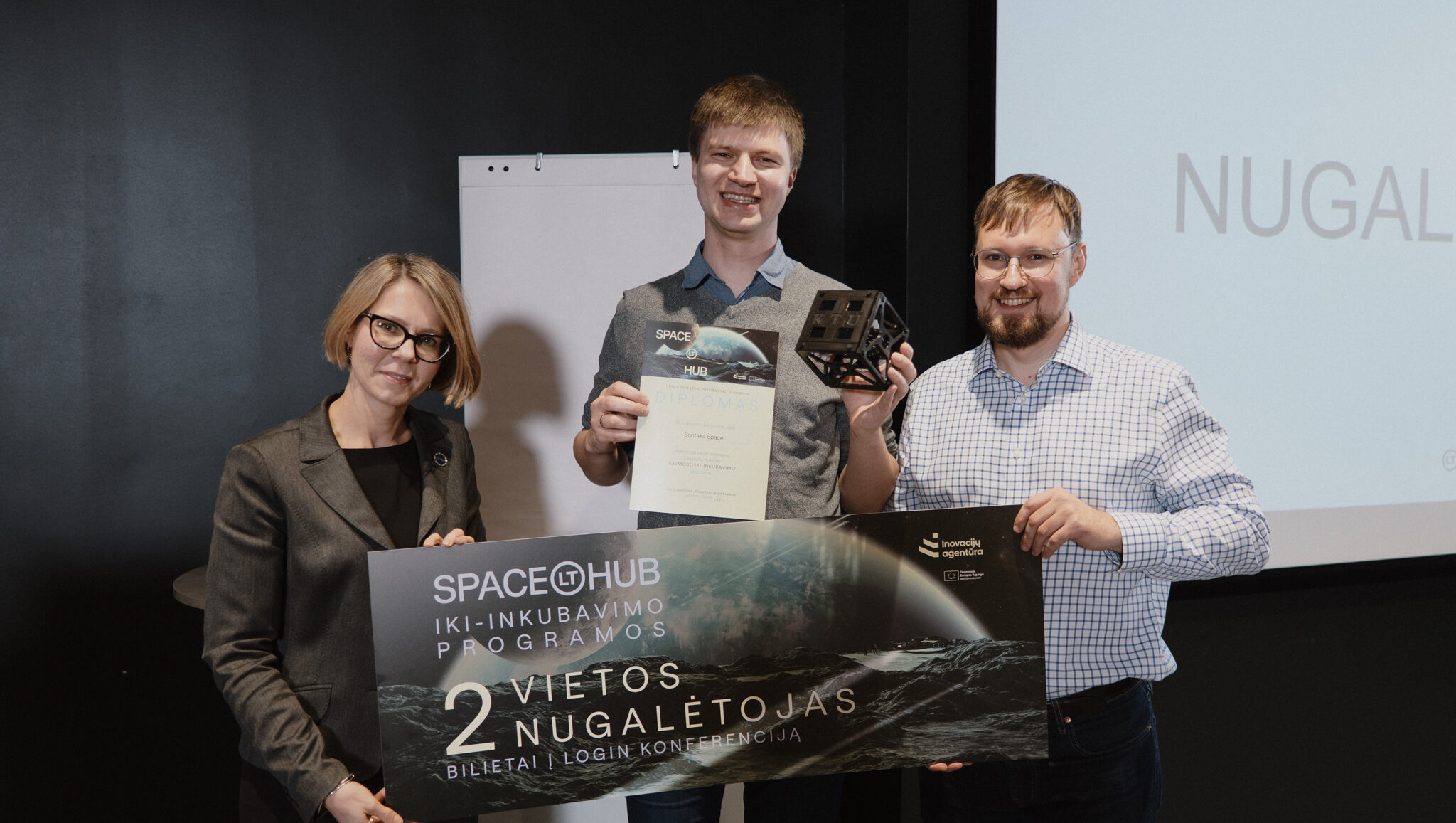
The KTU research team he leads, “Santaka Space” (Dr Deimantė Krisiūnė, Dr Kasparas Rakštys, Dr Ernestas Kasparavičius and Dr Saulius Burinskas), won a prize in the first cycle of the space pre-incubation programme organised by the Innovation Agency, aimed at developing and validating early-stage ideas in the space sector.
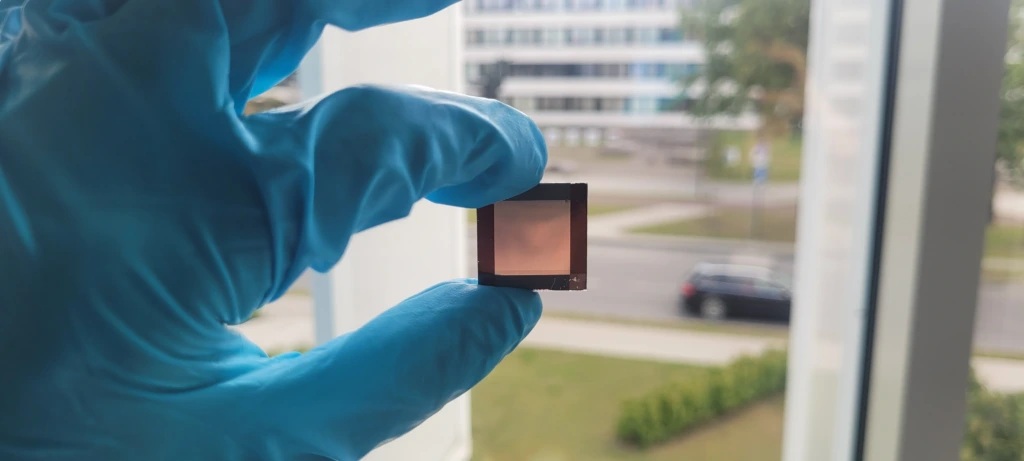
In the competition, KTU scientists proposed flexible perovskite solar panels with a high power-to-weight ratio (W/g) and a flexible manufacturing process that is not yet widely available on the market.
Explaining how perovskite solar cells differ from conventional rooftop solar modules, Dr Magomedov emphasises that the main distinction lies in how the materials are formed.
“Most solar cells require monocrystalline materials, whose formation consumes a great deal of energy. Perovskite, however, can be cast from solutions, bringing the technology closer to printing processes. Despite this manufacturing simplicity, it is possible to obtain a high-quality semiconductor,” Dr Magomedov stresses.
Weight Is the Key Constraint
Satellites are launched into Earth orbit using carrier rockets from spaceports. The payload such rockets can lift is highly limited—every gram costs a great deal of money. The lighter the satellite, the greater the savings.
According to Dr Magomedov, this is why the goal is to develop the lightest possible satellite components, including the solar cells. The cells his team is developing are not only lightweight – they can also be flexible. This makes it possible to pack larger solar arrays into the limited volume of a carrier rocket.
Dr Magomedov says that circumstances led them towards the space sector.
“After a long period of planning, at the beginning of 2025 we set up a solar-cell fabrication laboratory at KTU. Once we had refined the working processes, we began looking for niches for new research. Perovskite solar cells had for some time been – and still are – considered a promising space technology, but until last year it remained a largely fundamental field of research,” he explains.
High Added Value for Lithuania
However, a shifting market and promising early research results encouraged the team to pursue the topic in greater depth.
“It so happened that, during internships abroad, I worked with colleagues who were the first to study perovskites’ resistance to space radiation. So when the necessary technological capabilities emerged at KTU, this idea kept returning to me. The Innovation Agency’s space pre-incubation programme became an opportunity to step out of my comfort zone and hear different perspectives on technologies and products,” Dr Magomedov emphasises.
The idea recognised in the programme was developed by Dr Magomedov together with KTU colleagues Dr Deimantė Krisiūnė and Dr Kasparas Rakštys, while construction of the demonstrator for the competition was carried out by Dr Saulius Burinskas and Dr Ernestas Kasparavičius.
Looking ahead, Dr Magomedov notes that the scientific challenges are considerable – as they are for any researcher – because perovskite technology still requires substantial work to reach the reliability required for real-world deployment.
“But that is part of technology development. This is our team’s and the university’s attempt to contribute to technological progress in Europe and, if successful, to create high added value in Lithuania. To pupils and students who dream of space innovation in Lithuania, I would say: don’t just dream-act,” he adds.