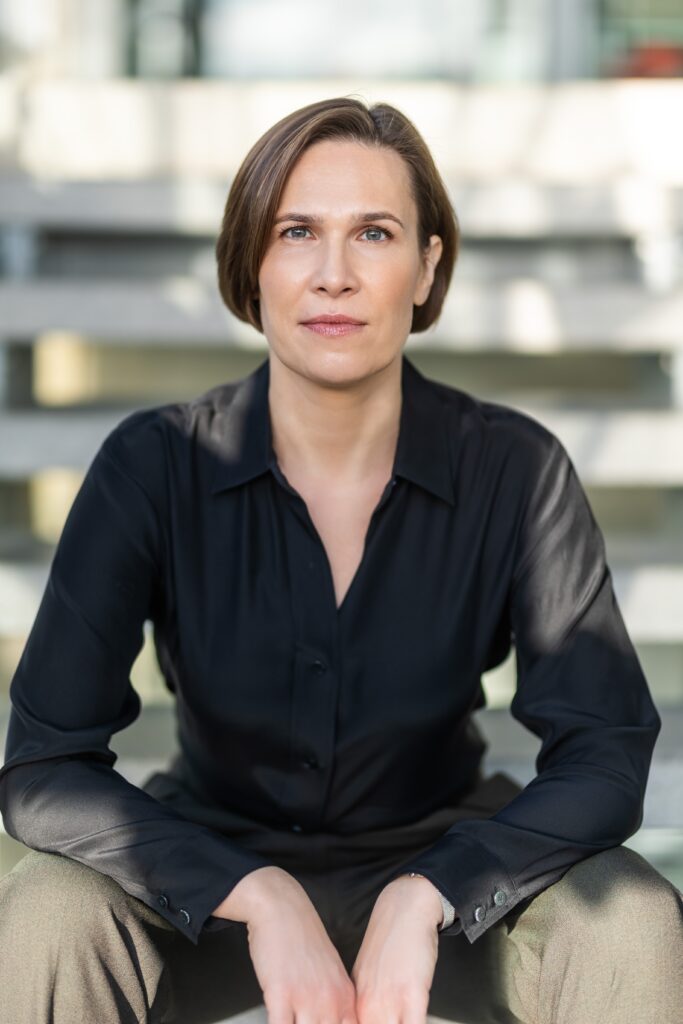
We sat down with Professor Urtė Neniškytė from Vilnius University Life Sciences Center (VU LSC) to discuss her groundbreaking research project into glycocalyx, the sugar-rich molecular structures found on brain cell surfaces. This marks the third time in four years that a project based at the VU LSC and European Molecular Biology Laboratory (EMBL) Partnership Institute, established at Vilnius University, has received a prestigious European Research Council grant. The full €2 million grant will allow Urtė to assemble a truly international team and co-operate with institutions across the EU. The results from her team’s research will provide proof, if any was needed, of the co-creative spirit of the Lithuanian Life Sciences Ecosystem.
Could you explain to us the subject of your research?
In this study, we are tackling a fundamental question: what is so special about the human brain? Why is it so much more potent compared to any other species on the planet?
Our main focus is to understand how the human brain matures—transitioning from the underdeveloped brains that we see in newborns through childhood and adolescence, into the mature, capable adult brain. We’re trying to capture different stages in this process and understand the mechanisms and underlying interactions between different cells, as well as the molecules involved. This relates back to the therapies required for neurodevelopmental diseases and disorders.
In particular, we’re interested in looking beyond neurons—the major cell type in the brain. It might come as a surprise, but neurons only comprise 10% of our brain, while the remaining 90% is composed of different types of cells. Ever since the lab was established seven years ago, we’ve been examining the interactions between neurons and other brain cells, and how they interplay during development.
In recent years, we’ve published several studies that revealed different aspects of this process, showing that immune cells in the brain are required to identify and remove those neuronal connections that are unnecessary for our mature, fully functioning brain. This is very important because about half of the connections formed during human brain development are eliminated by adulthood. Essentially, we form double the amount of connections that we need for the brain to function properly.
Why? That’s a very good question, and there are different hypotheses. One reason is that by forming more connections than needed, we gain flexibility. We can adapt the brain to the environment in which it’s developing. Interestingly, we know from clinical research that aberrations of this process lead to different disorders. For example, if too few connections are removed, it might lead to conditions on the autism spectrum—there is about a 30% increase in connections in autistic brains compared to neurotypical brains. On the other hand, diseases such as schizophrenia are related to over-pruning, when too many connections are eliminated, and the brain cannot function properly either.
The major question in our lab is: what defines this balance? How do we protect this balance in the developing brain and thereafter in the adult brain as well? In cases where there are certain deficits or issues with the pruning of neuronal connections, how can we address them? Can we develop new therapies? Can we develop new drugs?
So, you’re working with very big questions. How exactly do you intend to answer them?
In recent years, we’ve become very interested in the sugars that cover all our cells. Even though most of us who studied biology heard the term “glycocalyx” when studying cell compartments, for many, it is usually mentioned only once during their school years. Thereafter, the topic is forgotten because it’s an underresearched area of cell biology. But in recent years, cellular sugar coating has started to attract more interest, related to the development of technologies that can examine these molecules.
In our previous studies, we found that the type of sugars on the surface of neuronal cells determines the properties of the networks these neurons form. If there is too much of certain sugars, the network becomes over-connected. If there is too little, it becomes under-connected and not active enough.
What captured my own interest in glycocalyx is the fact that, from an evolutionary perspective, humans have unique genes for producing the glycocalyx. About a fifth of the genes required to add these sugars to the sugar trees on the cellular surface are unique to humans—different from even our closest relative, the bonobo chimp. Another interesting aspect, from a historical perspective, is that these changes in sugar genes occurred at the same time as we see the emergence of the genus Homo—when we see humans as a species emerging in history. For us, this indicates there’s something really important that defines us as a species, and that’s what we want to focus on and investigate.
The issue in the past has been that it was not possible to unravel the complexity of these sugars due to the limitations of the technology. We can imagine these sugar trees like seaweed in water. What happens if you drain the pond? All these weeds collapse on the bottom, and what was in three dimensions just becomes a flat pile. That’s what happened when we tried to look at cells using conventional electron microscopy, which requires the samples to be dried—dehydrated. As a result, in the images, the glycocalyx appeared to be just 20 to 40 nanometers thick. Nobody was interested in that—it appeared to be just a very thin layer on the surface of the cell.
But the emergence of cryo-electron microscopy allowed us to snap-freeze the cells as they are, and after imaging, to everyone’s amazement, the glycocalyx was revealed to be huge. On immune cells, the glycocalyx can reach up to 10 micrometers—a half of the cell’s diameter. On different types of cells, such as neurons, you can expect the glycocalyx to be about one micron thick. It’s a very important structural interface for cells to interact with each other, and any interaction between cells in the brain will be defined by whether the glycocalyx allows it to happen.
That’s fascinating. I’m assuming that the grant has also opened doors in terms of what you are able to do
In the past few years, we have seen a burst of technology in the field of glycomics—understanding the sugars of cells. To make this project feasible we work in close collaboration with very strong glycomics partners in Zagreb, Croatia, who have dedicated facilities and critical expertise for necessary analyses.
Another central question to this study concerns the specific gene modifications that occur in humans. To target those modifications and understand their function, we need the capacity to interact with them specifically, and this became possible with CRISPR-Cas technology. Being here at the Life Sciences Center is a unique setting for this type of project because we will be able to use new genome editing tools to target specific genome changes that happened when humans developed as a species, to understand how they changed the glycocalyx and how changes in the glycocalyx change how our brain forms.
So, you can see how this project not only creates the opportunity for co-creation with external labs but also within our own Center. Having such a fantastic international team here within VU LSC-EMBL Partnership Institute, also makes a huge difference. My colleagues such as Dr. Steve Jones and Dr. Patrick Pausch, who both develop gene editing technologies, and were also recipients of ERC grants, are a great sounding board as well as invaluable support.
It would appear that EMBL has been a successful venture in as much as it has been able to secure a steady flow of prestigious funding within its short life?
You could say that. There have been six ERC grants in Lithuania in total until now. Four of them have been at the Life Sciences Center, and three of them have been in the past three years within the Partnership Institute. This essentially shows that this type of collaboration as a Partnership Institute—which is costly and requires significant installation grants to establish the groups—actually brings more money back. And it not only gives back in terms of luring significant funding. It provides new technologies and new therapies—that’s the only way to develop them. If we only talk about genome editing, for example, we can now treat sickle cell anemia and thalassemia. There was a recent case where a genome editing tool was developed specifically for a child with a liver disorder—a baby in the UK. Essentially, we see it benefits everyone.
Do you have any final thoughts?
Lithuania has shown time and again that it has the strength, first of all, to dream, but then to do the work to make those dreams a reality. We see this looking all the way back to the restoration of independence. After all, we’ve gone from almost nothing to being one of the most successful economies in the EU in a space of 30 years. Think of basketball, our startups like Vinted and Nord VPN, even just our capital and how it has remade itself as a thoroughly contemporary and bustling centre. Here at VU LSC-EMBL Partnership Institute, we are now part of that narrative, and with our international team, we are showing how global we are not only in aspiration, but also world-class as an attractor of talent and ideas that will have a global impact.