
A decade ago, Lithuania set itself an ambitious goal: to become one of Europe’s leading financial technology hubs. Today, the country is home to 248 fintech companies employing around 7,800 specialists, while approximately 40 million customers across the European Union (EU) use the services of companies licensed in Lithuania. However, competition is intensifying, and attracting new companies alone is no longer enough. How did Lithuania become one of the sector’s leaders, and what will it take to maintain that position? We discuss these questions with Greta Ranonytė, Head of the Lithuanian Fintech Association.

Lithuania leads the EU in the number of licensed financial technology companies. Over the past decade, the country’s fintech sector has tripled in size, while the number of people employed in the industry has increased more than fivefold.
Nevertheless, the latest figures suggest that the nature of the sector’s growth is changing. At the end of 2024, Lithuania was home to 282 fintech companies, compared with 248 at the end of 2025. Although the number of companies has declined, the sector is becoming more mature, with greater importance being placed on scale, accumulated expertise and the ability to compete in international markets. According to Greta Ranonytė, Lithuania’s success was driven by favourable circumstances and the consistent efforts of public institutions. However, maintaining its leading position will require the country to identify new competitive advantages.
From Banking Competition to a Fintech Hub
The growth of Lithuania’s fintech sector began at a time when the country’s financial services market was dominated by a handful of major banks. The high concentration in the banking sector limited competition, prompting public institutions to look for ways to attract new market participants.
The Bank of Lithuania and the Ministry of Finance sought to create more favourable conditions for the development of alternative financial services, encourage innovation and attract foreign investment. In 2016, Lithuania began developing a targeted fintech policy, followed by the adoption of guidelines for the development of the financial technology sector in Lithuania in 2017. However, government initiatives alone would not have been enough. Lithuania’s efforts coincided with significant changes in the European financial market.
After the United Kingdom voted to leave the EU in 2016, financial services companies operating there began looking for ways to retain access to the European single market. Lithuania seized this opportunity. “Companies based in the United Kingdom needed to obtain a licence in Europe if they wanted to continue operating in the EU. We offered them the opportunity to obtain a licence in Lithuania and created favourable conditions to make that possible,” Greta Ranonytė explains.
One of Lithuania’s key advantages was an efficient licensing process and the opportunity for payment and electronic money institutions to use the Bank of Lithuania’s payment system, CENTROlink. According to the Association’s head, cooperation between public institutions also played an important role. A shared goal helped speed up decision-making and create an environment attractive to international financial technology companies. Over time, Lithuania saw growth not only in payment services but also in digital banking, investment, peer-to-peer lending and crowdfunding.
Licences Are Only Part of Lithuania’s Competitive Advantage
Today, licensing conditions are not the only factor fintech companies consider when deciding where to establish or expand their operations. The availability of skilled professionals, the regulatory environment and the expertise of supervisory authorities are equally important.
According to Ranonytė, over the past decade Lithuania has developed considerable expertise in anti-money laundering, financial institutions’ regulatory compliance and risk management. “We already had professionals in these fields and could hire them. But it was also important that, over the past ten years, our institutions developed deep specialised expertise of their own, including the Bank of Lithuania, the Financial Crime Investigation Service, the State Tax Inspectorate and others,” she says.
In her view, this experience is now one of Lithuania’s most important competitive advantages. Financial technology companies need not only professionals with technological expertise but also specialists capable of ensuring compliance with complex financial market regulations. It is equally important that supervisory authorities already have experience assessing a wide range of fintech business models. The ecosystem that has developed in Lithuania over the past decade enables major international companies to operate from the country while serving customers in other EU member states.
Established in Payments. Where Will the Next Wave of Growth Come From?
Although Lithuania is particularly strong in payment services, other parts of the financial market still offer untapped potential. One such area is investment services and capital markets.
Ranonytė points out that payment service providers dominate Lithuania’s fintech sector, while the range of investment services could be considerably broader. According to her, Lithuania has more than 100 payment institutions, compared with 17 crowdfunding platforms, fewer than 30 collective investment undertakings and just 15 financial brokerage firms. This difference highlights the uneven development of individual segments of the financial market and raises the question of where future sector growth could be directed.
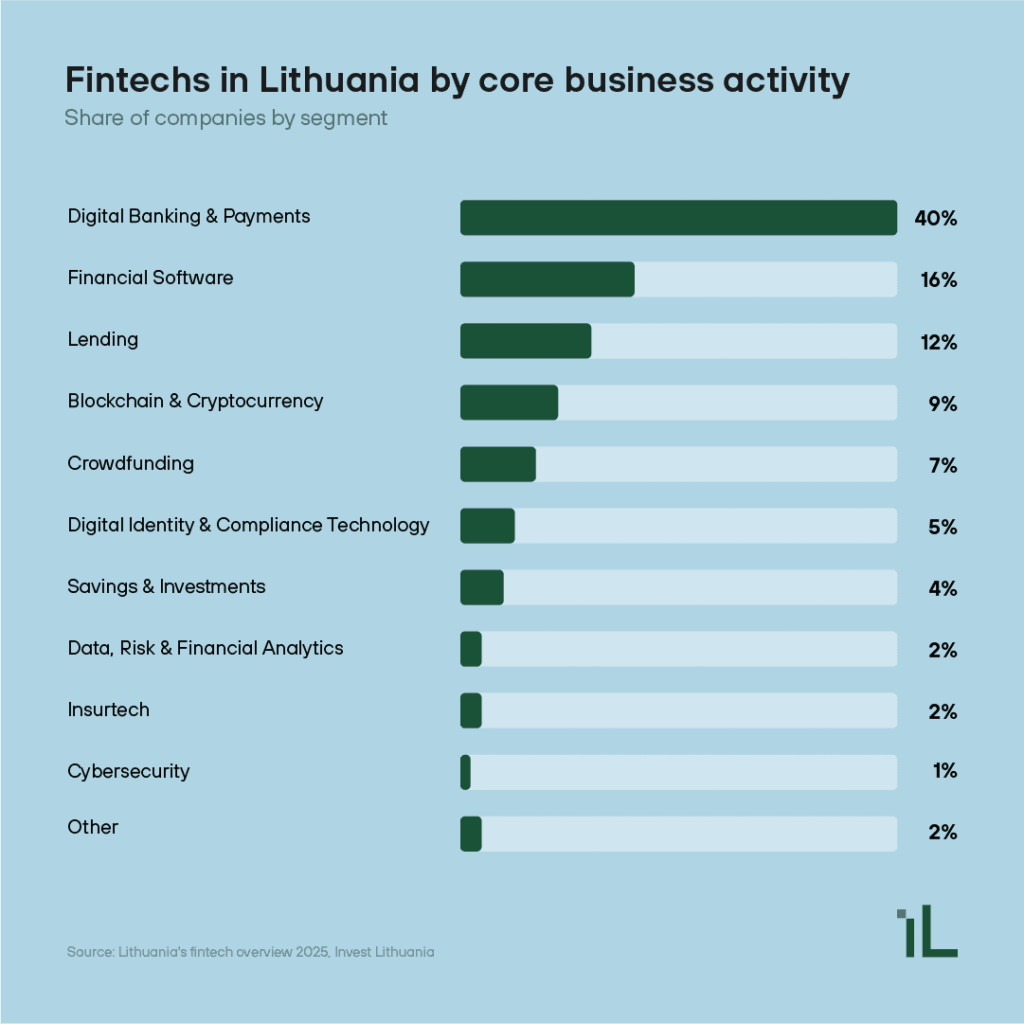
“The more innovative and easy-to-understand solutions we offer people for putting their money to work, the more financial literacy will grow in Lithuania, allowing people to achieve better financial returns,” the Association’s head says.
In her view, new investment solutions could encourage residents to take a greater interest in capital markets and give them more opportunities to manage their finances. This would also open up a new direction for Lithuania’s fintech sector, which until now has grown primarily through the expansion of international payment services.
Artificial Intelligence Is Changing the Rules of the Game
Another factor that could fundamentally transform the financial services market is artificial intelligence (AI). Fintech companies can already use AI solutions for customer service, fraud prevention, risk assessment and the automation of internal processes. In the future, AI agents could become personal financial assistants, helping people plan their budgets, manage expenses or carry out financial transactions within the limits of the authorisation granted by the user. However, these new technologies also present fresh challenges for financial institutions and their supervisory authorities.
One of the main tasks will be to ensure that automated financial transactions are secure and comply with anti-money laundering and other regulatory requirements. G. Ranonytė gives an example of how the use of AI agents could change conventional transaction monitoring practices.
“If a person makes a payment at night, the system may flag it as unusual and stop the transaction. However, an AI agent can operate at any time of day. This raises the question of how to distinguish a legitimate action initiated by the user from one that may be fraudulent or unauthorised,” she explains.
According to the interviewee, as technology advances, financial institutions will also need to adapt their risk assessment methods. This means that, in the future, a competitive advantage will belong not only to companies that develop new products the fastest but also to those that can combine innovation with reliable risk management.
How Can Lithuania Maintain Its Leading Position?
Lithuania has successfully capitalised on favourable circumstances and established itself in the European financial technology market. However, competition for investment and fintech companies is intensifying.
According to Ranonytė, one of Lithuania’s greatest advantages so far has been its flexibility and ability to cooperate. In a relatively small market, institutions, associations and businesses can find common solutions quite quickly. Nevertheless, as the sector grows and matures, the main challenge is no longer simply attracting new companies but also ensuring the right conditions for existing businesses to expand.
She emphasises that Lithuania needs to take a more active role in shaping EU financial market regulations and ensure that new requirements do not create unnecessary barriers for innovative businesses. Regulation is essential in the financial services sector to protect consumers, maintain financial stability and prevent money laundering. However, overly complex procedures and lengthy decision-making processes can make it harder for European companies to compete with businesses from the United States and China.
“If we want to compete not only regionally but globally, our companies have what it takes. However, we must constantly consider how to create the right conditions for them to expand and operate across the EU without imposing excessive regulatory burdens,” Greta Ranonytė says.
According to her, Lithuania should not simply adapt to decisions made in Brussels but take a more active role in shaping them. “My message to public institutions would be to defend the market more confidently and proactively whenever changes are being considered in Brussels,” the Association’s head emphasises