Lithuanian space technology company Astrolight has achieved a significant milestone in satellite communications, establishing routine, high-speed laser links between a satellite in orbit and a ground station in Greece. Operated remotely from Lithuania, the system delivers autonomous data transmission at 1 gigabit per second, demonstrating the technology’s readiness for regular operations and bringing high-capacity optical connectivity closer to widespread commercial use.
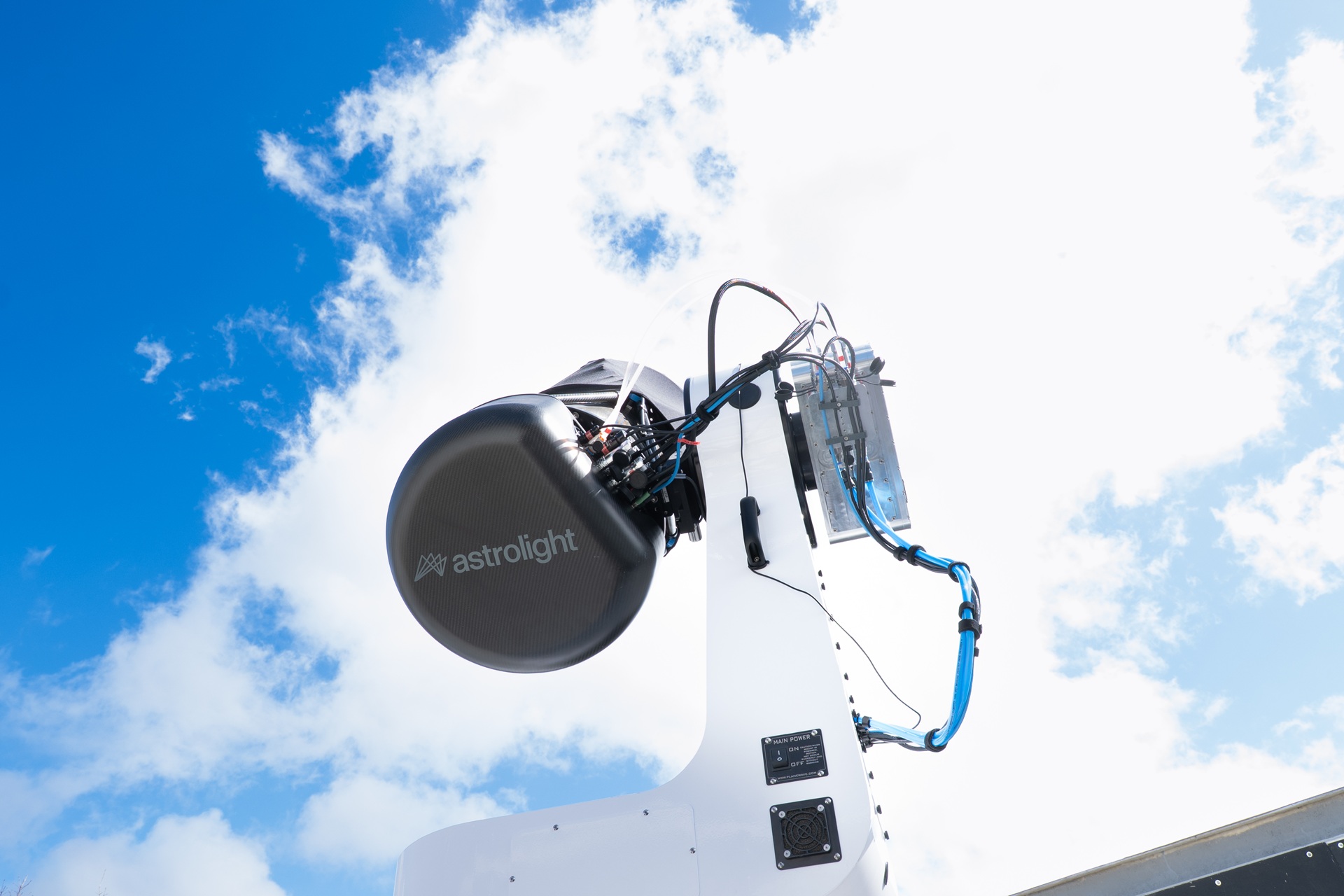
The achievement, announced on 8 October 2026, marks the first successful in-orbit operation of Astrolight’s ATLAS-1 laser communication terminal. Working with the National and Kapodistrian University of Athens and Aristotle University of Thessaloniki, the Lithuanian company established an autonomous connection between the ERMIS-3 nanosatellite and an optical ground station in Greece.
Within just one week of the first connection, the system progressed to routine operations, transmitting data at 1 gigabit per second (Gbps) through two scheduled links daily.
Unlike conventional satellite communications, which rely on radio frequencies, optical systems use laser beams to transmit information. The technology offers the potential for higher transmission capacity and reduced radio-frequency interference, making it increasingly important as satellite networks expand.
From a Technical Breakthrough to Routine Operations
The speed of the achievement was particularly notable. Astrolight’s satellite terminal and ground station established their first connection during the satellite’s first active pass. By the third pass, both systems were fully calibrated and operating autonomously.
The technology also demonstrated its ability to operate under challenging conditions, including cloud cover and temporary obstructions. Following calibration, link availability exceeded 85% during satellite passes above 15 degrees of elevation. Interrupted connections could be re-established in less than 10 milliseconds.
For commercial satellite operators, this combination of speed, reliability and autonomy is essential to making laser communications practical at scale.
“The next step for laser communications is making them routine for satellite operators, with high-capacity links that can be deployed and operated remotely with minimal operational oversight,” said Dalius Petrulionis, Astrolight’s Chief Technology Officer and Co-Founder.
Lithuanian Technology Supporting Europe’s Space Connectivity
The breakthrough forms part of Astrolight’s growing contribution to European space communications infrastructure.
Beyond its operational ground station in Greece, the company is developing another station in Greenland in cooperation with the European Space Agency (ESA). It is also working on three next-generation laser communication terminals – ATLAS-2, ATLAS-X-MINI and ATLAS-X – designed to support increasingly demanding space-to-ground and inter-satellite connections.
The most advanced system, ATLAS-X, is being developed to support data transmission speeds of up to 400 Gbps, with commissioning planned as part of ESA’s HydRON project in 2028–2029.
The ERMIS and PeakSat missions are funded through Greece’s recovery programme and Ministry of Digital Governance, with support from ESA and the Hellenic Space Centre.
As demand for satellite data grows, the ability to transmit information quickly and reliably will become increasingly important. Astrolight’s achievement demonstrates how Lithuanian engineering expertise is helping build the communications infrastructure for the next generation of European space missions.
This article was prepared based on a press release issued by Astrolight on 8 October 2026.