
Lithuania has taken the lead in the European Union in the use of advanced artificial intelligence, according to a new study by OpenAI. The country ranks first for the share of business AI activity carried out using agentic AI tools, highlighting how Lithuanian organisations are moving beyond experimentation towards more sophisticated applications of the technology.
The findings come from Europe’s Agentic Opportunity: Moving from Breadth to Depth with AI Agents, a report by OpenAI Economic Research examining how European businesses are adopting AI systems capable of carrying out complex tasks with greater autonomy.

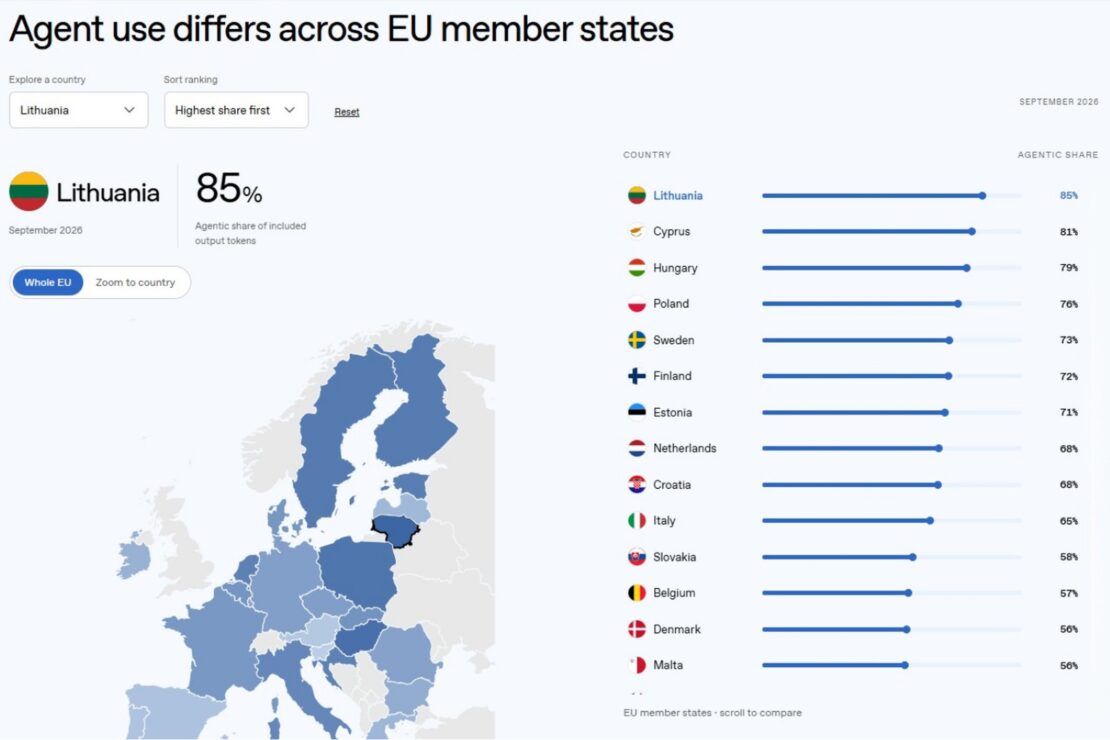
Among Lithuanian organisations included in the study, agentic AI accounted for 85% of output generated using OpenAI’s business tools in September 2026 – the highest share in the EU, ahead of Cyprus (81%) and Hungary (79%).
“Lithuania’s leadership in agentic AI demonstrates that our organisations are quick to adopt cutting-edge technologies and turn them into practical solutions. We must capitalise on this potential to boost productivity, strengthen business competitiveness and create greater value for the Lithuanian economy,” says Edvinas Grikšas, Lithuania’s Minister of the Economy and Innovation.

Agentic AI represents a significant step beyond conventional AI applications. Rather than simply responding to questions or generating content, AI agents can plan and execute multi-step tasks, analyse data and support decision-making. This allows businesses to integrate AI more deeply into their operations, opening up new opportunities to improve productivity and efficiency.
According to Titas Budreika, an economist at Lithuania’s Ministry of the Economy and Innovation, the findings place Lithuania at the forefront of this shift.
“The study shows that agentic AI accounts for as much as 85% of the output generated by Lithuanian organisations using OpenAI’s business tools. This suggests that organisations are moving beyond simply testing new technologies and increasingly incorporating them into their everyday workflows,” says Budreika.

The OpenAI study measures the proportion of output generated through its agentic tools, Codex and ChatGPT Work, among the business accounts analysed. The figure therefore reflects the intensity of agentic AI use within the study sample, rather than the proportion of Lithuanian businesses using the technology.
AI adoption accelerates across Lithuania
Lithuania’s strong performance comes amid a wider acceleration in AI adoption across the country’s business sector.
According to the Ministry of the Economy and Innovation, the proportion of Lithuanian companies using AI technologies has increased 2.5-fold over the past year, representing the fastest growth among EU member states.
Lithuania is also investing in the infrastructure needed to support further advances in AI. The country is establishing LitAI, a new AI competence and technology centre that is expected to become the only AI factory of its scale in the Baltic states.
“The rapid growth in AI adoption, combined with investment in infrastructure such as LitAI, reflects the increasing readiness of Lithuanian businesses to harness AI to improve efficiency and develop new competitive advantages,” Budreika explains.
From technological adoption to economic growth
The potential benefits of AI extend well beyond improvements in individual business operations.
An analysis by Lithuania’s Ministry of the Economy and Innovation suggests that the country’s gross domestic product (GDP) could increase by as much as 17% over the next decade if Lithuania moves closer to leading Organisation for Economic Co-operation and Development (OECD) countries in the development of innovative digital businesses.
The estimate illustrates the potential contribution of digital innovation to Lithuania’s long-term economic performance and reinforces the importance of helping businesses adopt and make effective use of emerging technologies.
With AI adoption gathering pace and new infrastructure under development, Lithuania has an opportunity to turn its early lead in advanced AI use into a lasting competitive advantage.
The next challenge is to ensure that this technological momentum translates into higher productivity, more innovative businesses and sustainable economic growth.
Based on information provided by Lithuania’s Ministry of the Economy and Innovation and the OpenAI Economic Research report, Europe’s Agentic Opportunity: Moving from Breadth to Depth with AI Agents (October 2026).