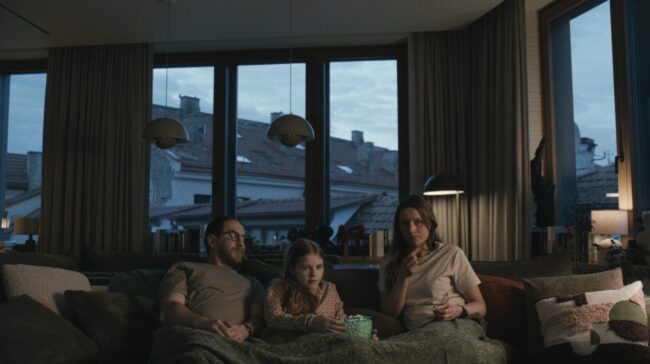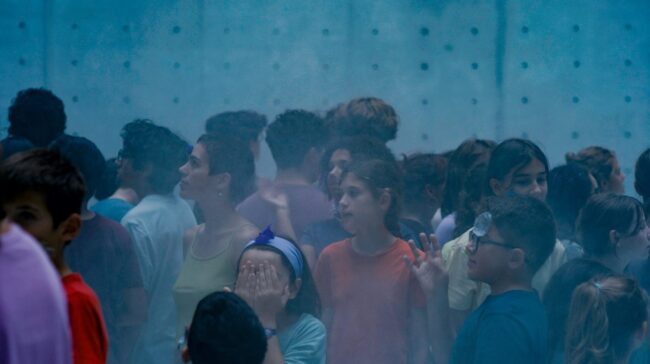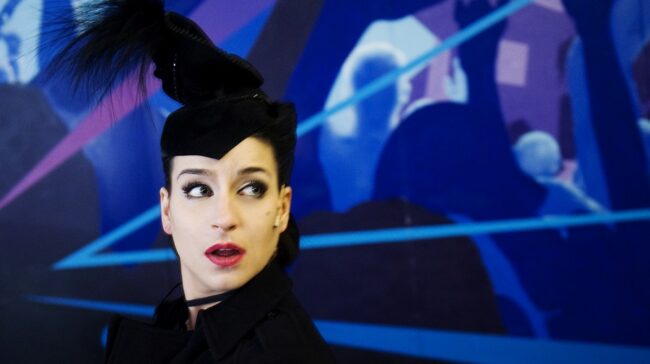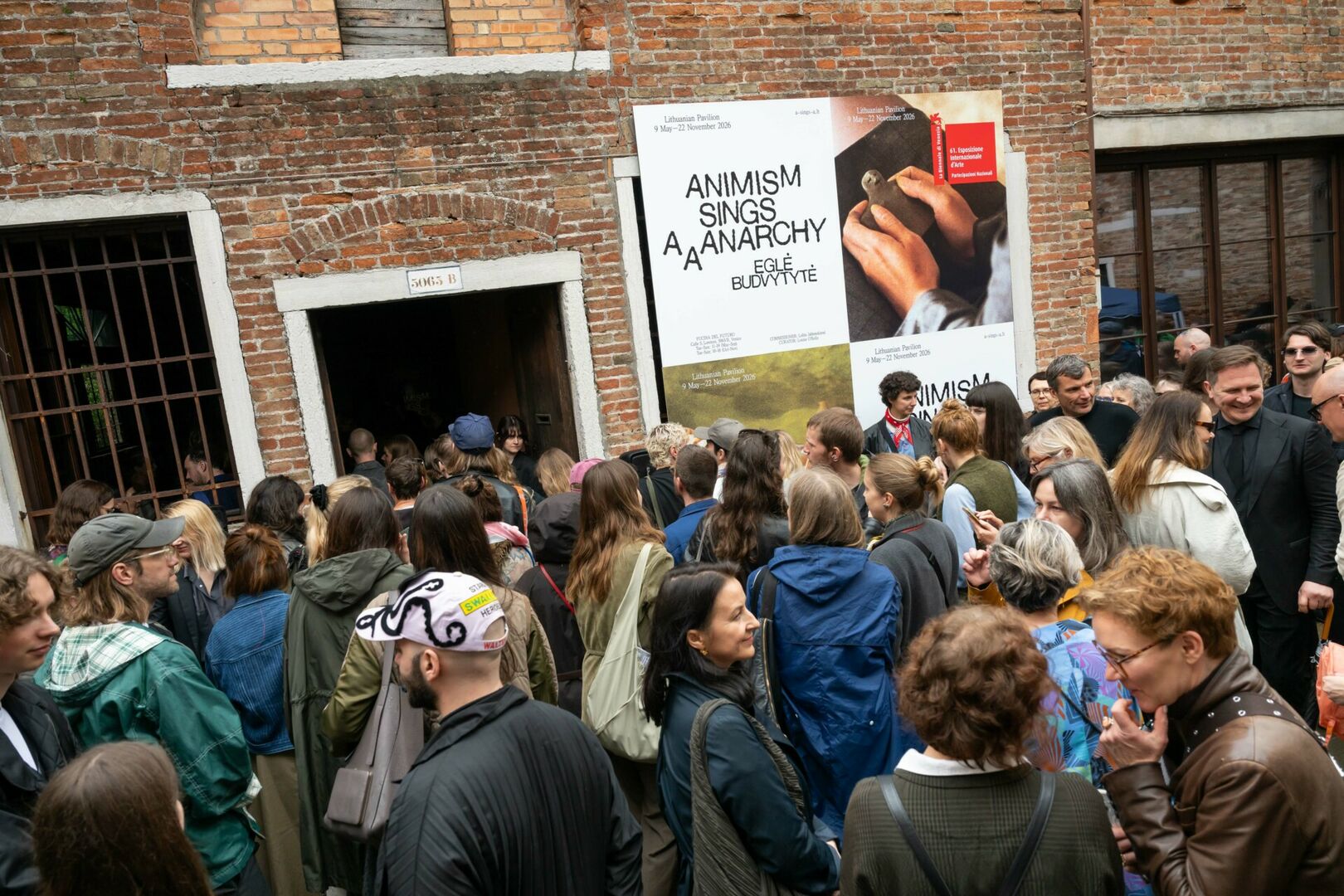
The Lithuanian Pavilion has opened at the 61st Venice Biennale of Contemporary Art. Organised by the Lithuanian National Museum of Art, this year’s pavilion presents Eglė Budvytytė’s film installation gyva gyva-ta (animism sings anarchy) at the project space Fucina del Futuro.
The pavilion was officially opened on 6 May, with remarks from pavilion commissioner Dr Lolita Jablonskienė, artist Eglė Budvytytė, curator Louise O’Kelly, Federico Mollicone, Member of the Italian Chamber of Deputies and Chair of its Culture Committee, Lithuania’s Minister of Culture Vaida Aleknavičienė, and Dr Arūnas Gelūnas, Director General of the Lithuanian National Museum of Art.
The international audience gathered for the opening was the first to see Budvytytė’s new film, created especially for the Biennale. In Venice, gyva gyva-ta is presented as a three-screen installation, with exhibition architecture by Marija Olšauskaitė.
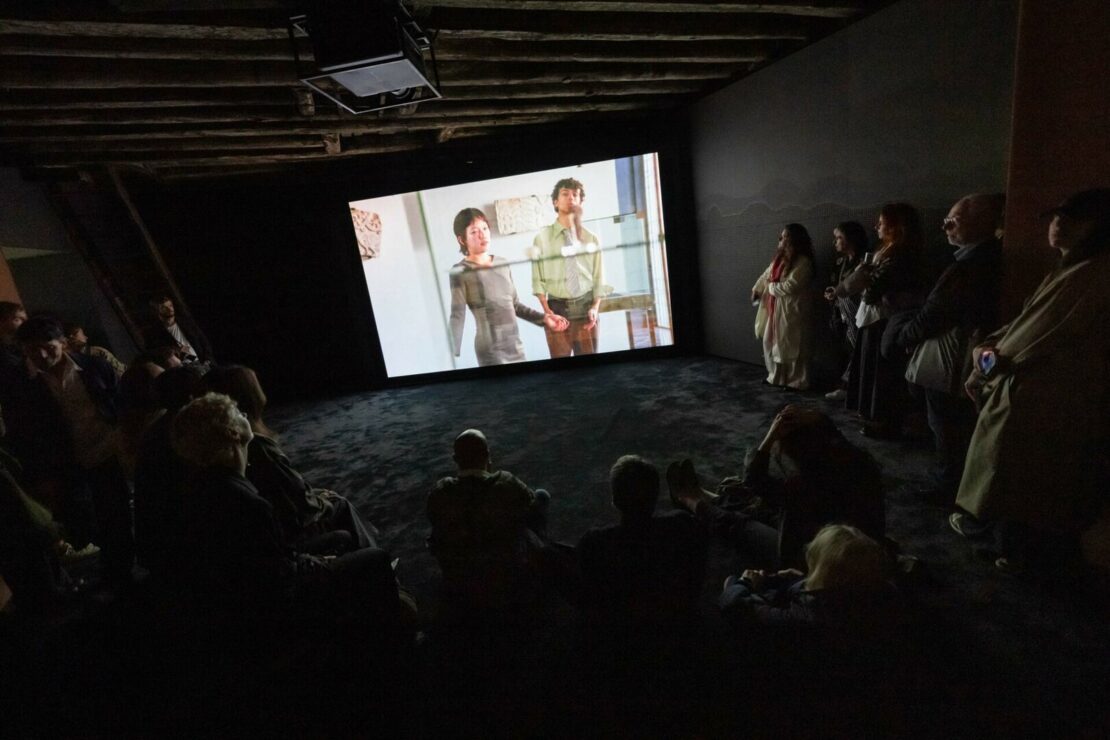
“Participation alone is not enough at the Biennale; what matters more is the ability to move beyond what is familiar and to seek new ways of seeing. Eglė Budvytytė’s work offers a multilayered, sensitive perspective that brings together different experiences of time. One of the most important qualities of her practice is a commitment to collaboration. Her works grow through dialogue and the nurturing of relationships. This collective dimension becomes not only a method, but also a position,” said Dr Jablonskienė at the opening.
Shot on 16 mm film, gyva gyva-ta is a performative and poetic interpretation of archaeological research through song, movement and landscape. The work takes as its point of departure the studies of matrilineal, animist Neolithic societies carried out by the Lithuanian-American archaeologist and anthropologist Marija Gimbutas / Marija Gimbutienė (1921–1994).
Budvytytė has noted that “devotion” and “dedication” were among the key ideas guiding her thinking about the choreography of bodies in relation to nature, archaeological artefacts and the very notion of prehistory.
The film was shot in two locations in Italy: the Museum of Civilisations in Rome and Apulia, near Grotta Scaloria, a Neolithic water-cult site where Gimbutas and other archaeologists conducted excavations in the 1970s.
The architecture of the pavilion also draws on archaeological and ritual references. The newly installed walls evoke clay ceramic vessels long used in rituals and ceremonies. Their surfaces are coated with clay excavated in Ukmergė, near the River Šventoji in Lithuania.
According to Dr Gelūnas, the work presented in the Lithuanian Pavilion – which speaks of the possibility of matrilineal, non-hierarchical and non-violent coexistence – takes on additional meaning in today’s geopolitical context.
“Cultural exchange strengthens ties between countries and builds trust even in difficult circumstances. Even the rain accompanying the opening can be understood as a favourable sign from animist deities — rain encourages growth. I believe this project will contribute to long-term cooperation and to strengthening cultural resilience,” he said.
Federico Mollicone has also publicly underlined that, in the current circumstances, fundamental questions arise regarding the participation of aggressor states in cultural events. In his view, such situations make it difficult to speak of free artistic expression, as it may be replaced by state-controlled representation; decisions on participation must therefore be assessed with particular responsibility.
Following the opening, the Lithuanian, Latvian and Estonian pavilions initiated a solidarity procession in support of Ukrainian culture and artists. Symbolically linking the Baltic pavilions, the procession highlighted a shared historical experience and a continued commitment to supporting Ukraine.
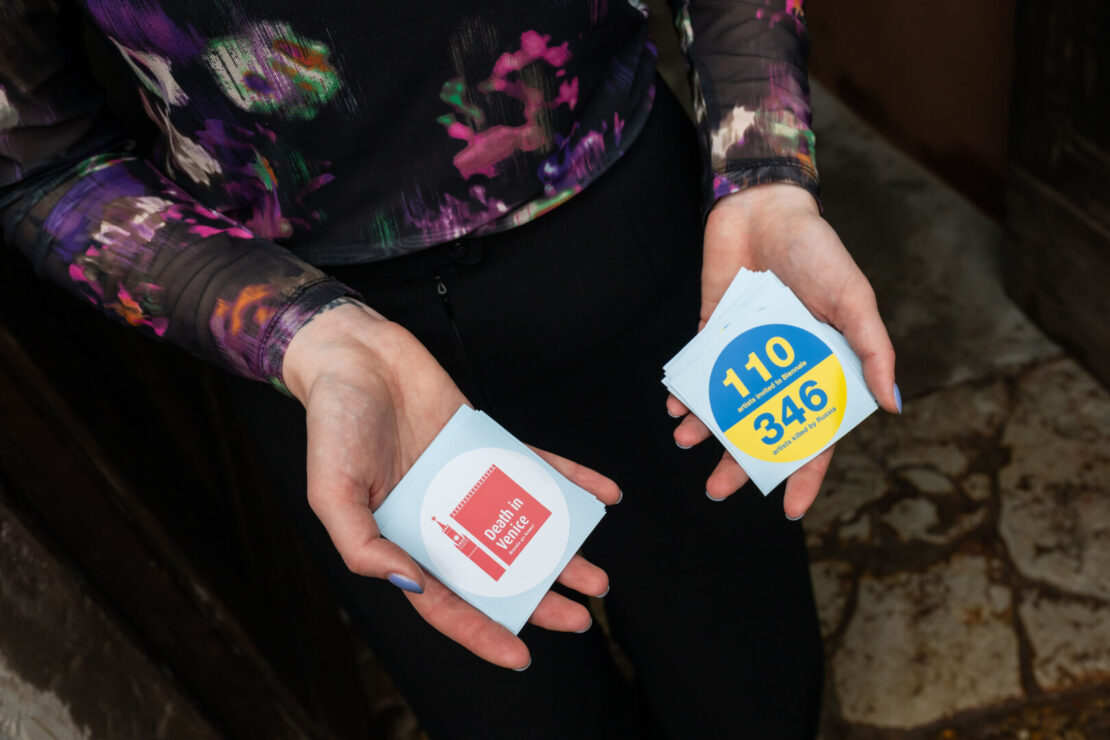
The Baltic states expressed solidarity with Ukraine’s cultural community, which continues to work under wartime conditions, and invited Biennale visitors to engage with Ukrainian artists’ projects in Venice, including Ukraine’s national pavilion and Still Joy – From Ukraine Into the World, an exhibition organised by the PinchukArtCentre and the Victor Pinchuk Foundation.
The opening of the Lithuanian Pavilion took place amid wider controversies surrounding this year’s Biennale. The decision to allow states pursuing policies of occupation and terrorism to participate has drawn international criticism, with a number of art-world figures and institutions voicing their opposition. A few days before the Biennale opened, the official jury resigned, meaning that the traditional awards – the Golden Lion and special mentions – were not presented at the opening.
Held every two years, the Venice Art Biennale is one of the world’s most prestigious contemporary art events. Lithuania’s participation this year is implemented by the Lithuanian National Museum of Art and partly funded by the Lithuanian Council for Culture.
The 61st Venice Art Biennale will run until 22 November.